
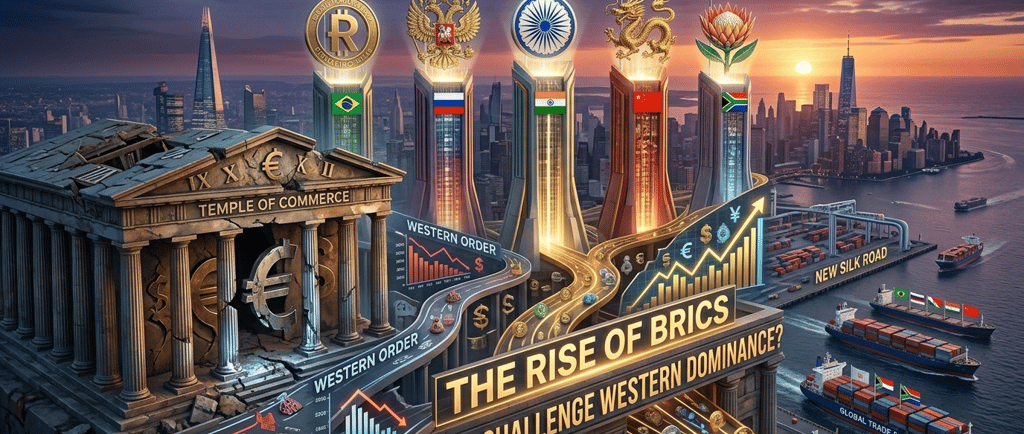
The Rise of BRICS: Can It Challenge Western Dominance?
Understanding the growing influence of emerging economies in a changing world order
12/22/20255 min read
Introduction
For decades, global power was largely concentrated in the hands of Western countries led by the United States and Europe. Institutions such as the World Bank, the International Monetary Fund (IMF), and the US dollar dominated international trade, finance, and diplomacy. But over the last two decades, a new grouping of nations has steadily gained influence on the global stage. That group is BRICS.
Originally formed by Brazil, Russia, India, China, and South Africa, BRICS was created as a platform for emerging economies to cooperate on trade, development, and global governance. Today, BRICS is no longer viewed as just an economic club.With new countries joining the bloc and discussions around alternative financial systems increasing, many analysts are asking a serious question:
Can BRICS challenge Western dominance in global politics and economics? The answer is complicated — but increasingly important.
What Is BRICS and Why Was It Formed?
The term “BRIC” was first used in 2001 by economist Jim O’Neill to describe four rapidly growing economies:
Brazil
Russia
India
China
South Africa joined later in 2010, turning BRIC into BRICS.
The idea behind the group was simple: The global system was heavily influenced by Western countries, while emerging economies had limited representation despite their growing populations and economic strength.
BRICS countries wanted:
Greater influence in global decision-making
Stronger economic cooperation
Reduced dependence on Western institutions
More balanced global governance
Over time, BRICS evolved from an economic discussion platform into a geopolitical grouping with global ambitions.
Why BRICS Is Becoming More Powerful
One major reason behind BRICS’ rise is numbers. Together, BRICS countries represent:
A large share of the world’s population
Significant natural resources
Expanding industrial capacity
Rapidly growing consumer markets
China is the world’s second-largest economy.
India is among the fastest-growing major economies.
Russia remains a major energy and military power.
Brazil is an agricultural giant.
South Africa plays an important role in Africa’s economy and diplomacy.
In recent years, BRICS has also expanded by welcoming new countries, including major energy producers from the Middle East. This expansion matters because it increases:
Energy influence
Trade connectivity
Financial cooperation
Political leverage
The bloc is gradually transforming into a broader coalition of countries seeking a stronger voice in world affairs.
The Real Issue: The Global Financial System
At the center of the BRICS discussion is one important issue — the dominance of the US dollar. For decades, global trade has largely depended on the dollar. Countries buy oil, conduct international trade, and maintain reserves mainly in US currency. This gives America enormous financial influence. It also allows Washington to use sanctions as a geopolitical tool by restricting access to dollar-based financial systems.
Many BRICS nations are now exploring alternatives:
Trading in local currencies
Reducing dependence on the dollar
Strengthening independent payment systems
Increasing cooperation through BRICS financial institutions
The creation of the New Development Bank (NDB), often called the BRICS Bank, was one such step. The goal is not necessarily to destroy the dollar immediately — that is unrealistic in the near future. The real objective is to reduce excessive dependence on Western-controlled financial systems.
Why Many Countries Are Interested in BRICS
Several developing nations see BRICS as an opportunity to balance Western influence.
Some countries feel that:
Global institutions often favor wealthy Western economies
Developing nations receive unequal treatment
International financial systems can become politically influenced
For these nations, BRICS represents:
A multipolar world order
Greater economic flexibility
Alternative partnerships
Reduced geopolitical pressure
This is one reason why interest in joining BRICS has increased significantly in recent years. Countries are not necessarily anti-West.
Many simply want more options.
The Challenges Facing BRICS
Despite its growing influence, BRICS faces major internal challenges. The biggest challenge is unity. The member countries have very different political systems, economic priorities, and geopolitical interests. For example:
India and China have border tensions
Russia faces Western sanctions
Brazil’s foreign policy changes with leadership
China’s economy heavily dominates the group
Unlike NATO or the European Union, BRICS is not a military alliance or a deeply integrated political union. It is a loose coalition built mainly on shared interests. Another major challenge is replacing the US dollar. The dollar remains dominant because:
Global investors trust it
American financial markets are strong
International trade systems are deeply connected to it
Creating an alternative system requires time, stability, and trust. BRICS still lacks a unified currency, centralized structure, and fully integrated financial framework.
India’s Unique Position Inside BRICS
India occupies a very interesting position within BRICS. India works closely with:
BRICS
The United States
The Quad
European nations
Gulf countries
Rather than choosing one side, India follows a strategy of strategic multi-alignment. India supports:
A multipolar world
Greater representation for developing countries
Economic cooperation within BRICS
At the same time, India also maintains strong ties with Western economies. This balanced approach allows India to protect its national interests while participating in multiple global platforms. For India, BRICS is not about replacing the West entirely. It is about ensuring that global power becomes more balanced and inclusive.
Can BRICS Really Challenge Western Dominance?
The answer depends on what “challenge” means. If the question is: Can BRICS completely replace Western institutions soon? Probably not. The United States and Europe still dominate:
Global finance
Technology
Military alliances
Currency systems
Higher education
Advanced innovation
However, if the question is: Can BRICS reduce Western dominance and create a more multipolar world? Then the answer is increasingly yes. The rise of BRICS signals an important shift: Global power is becoming more distributed. Emerging economies no longer want to remain passive participants in a system designed primarily by Western powers after World War II. They want greater influence, greater representation, and greater strategic independence. And slowly, they are gaining it.
Conclusion
BRICS is not yet a replacement for Western power. But it is becoming an increasingly important force in shaping the future global order. Its growing influence reflects deeper global changes:
The rise of emerging economies
Dissatisfaction with existing institutions
Increasing demand for strategic independence
The shift toward a multipolar world
Whether BRICS ultimately becomes a transformative global alliance or remains a flexible economic coalition will depend on how effectively its members overcome internal differences. But one thing is already clear: The era of unquestioned Western dominance is gradually evolving into a world where power is shared among multiple centers of influence. And BRICS is playing a major role in that transformation.
Key Takeaways
BRICS was formed to increase the influence of emerging economies
The group seeks greater balance in global governance
Many countries view BRICS as an alternative to Western-dominated systems
Reducing dependence on the US dollar is a major long-term goal
Internal differences remain BRICS’ biggest challenge
BRICS is contributing to the rise of a multipolar world order
For Students
UPSC GS-II Relevance:
International Relations
Global Governance
India’s Foreign Policy
Multipolar World Order
UPSC GS-III Relevance:
Global Economy
International Financial Institutions
Trade and Development
Debate Topic:
“Can BRICS realistically reduce the dominance of the United States in global affairs?”
Test Your Knowledge (TYK)
1. What was the primary purpose behind the formation of BRICS?
A) To create a military alliance against NATO
B) To promote cooperation among emerging economies and increase their global influence
C) To replace the United Nations
D) To establish a single global currency
Which of the following countries joined BRICS later, turning “BRIC” into “BRICS”?
A) Saudi Arabia
B) Indonesia
C) South Africa
D) Argentina
Why is the US dollar considered highly influential in the global financial system?
A) It is controlled by the United Nations
B) Most international trade and reserves are linked to it
C) It is backed by gold only
D) It is used only by Western countries
What is one major challenge facing BRICS?
A) Lack of natural resources
B) Absence of member countries with large populations
C) Internal differences and conflicting geopolitical interests
D) Lack of global recognition
India’s approach within BRICS can best be described as:
A) Complete alignment with Western countries
B) Isolation from global alliances
C) Strategic multi-alignment and balanced diplomacy
D) Military expansionism
Answers: BCBCC
Published by:
ICL Research & Editorial Desk
ICL Vidyapeeth
Did You Know?
BRICS countries together account for nearly half of the world’s population and a significant share of global economic growth — making the bloc one of the most influential alliances outside the Western world.